Not a Fund
Why the most powerful capital structure in lower-middle-market private investing is certainly not a fund, and why a 120-year-old model consistently generating 10x more alpha than US buyout is still treated as a curiosity in the United States.
36%
Constellation Software annualized TSR from IPO (2006) to Dec 2025
~10x
More Alpha generated from 2006-2021 than the US PE industry
+17
Points of EV/EBITDA multiple Röko gained between serial-acquiring for 7x and IPO for 24x
22.5%
Lifco EBITDA CAGR, 2001-2025
Programmatic Compounders are a class of small-businesses serial-acquiring holding companies, traceable to 1894, that has quietly out-returned every other private-capital format and investor on a multi-decade basis.
Since 2005, the basket of the publicly listed players compounded 17.9% per annum, against 12.3% for the median US PE fund, 10.9% for the S&P 500. During these twenty years they multiplied total returns to shareholders by 23x, several exceeding 50x (up to 1,100x for Heico), to be compared to Berkshire’s 3x during the same window. Newcomer Röko, founded in 2019 and exclusively acquiring non-glamorous $2-10M EBITDA businesses, went from zero to twenty-eight subsidiaries in five years, IPOing as recently as 2024 at 24x its cumulative $120M EBITDA, delivering close to 10x to its early backers.
The cohort, by and large Nordic and British, includes Investor AB, whose excess balance-sheet cash gave birth to EQT, the world's third-largest PE firm by AUM today; emblematic Bergman & Bevin and its spin-offs Addtech, Lagercrantz, AddLife and Momentum; and many others such as Indutrade, Lifco, Beijer Ref, Atlas Copco, Halma, Diploma, Judges Scientific, Heico, Ametek, Roper, Brown & Brown, Teledyne. The model is what Buffett pivoted to from his cigar-butt approach under Munger's fifteen-years insistence, and what Mark Leonard chose in 1995 to build Constellation Software out of a mere $18 million in funding, and today own over 1,000 niche vertical-market software subsidiaries with roughly 100 more acquired every year. From its 2006 IPO to year-end 2025, Constellation's stock compounded at roughly 36% per annum, beating every Magnificent Seven member, while building exclusively on unglamorous $1-4M ARR SaaS targets.
These returns champions share five doctrinal pillars, each contrarian to US private-investing convention: IPO-able holding companies rather than 2/20 funds; Buy-and-hold, indefinitely; Sector-agnostic or very broad spectrum; Radical decentralization "close to abdication" (Munger); and a Visceral commitment to value investing and cash returns on equity, over narrative, scale or theoretical IRRs.
The model's near-absence from the segment it most decisively outperforms - the $13T US lower-middle market where ~300,000 companies are for sale every year and growing with the ‘Silver tsunami’ - is a structural anomaly.
What follows is what the data shows, and why the US anomaly.
I write as the founder of one such US compounders.
Summary
The textbook description, that Programmatic Compounders buy small profitable niche businesses, hold them forever and let them run, misses what matters. Five features distinguish the model from anything resembling US private equity, and all five are policy choices the best practitioners refuse to compromise even when capital markets reward the opposite.
The playbook
1. IPO-able Holdco, not a 2/20 fund
No fee drag, no ever-larger vintages, no ten-year clock, no forced exits, not ‘Limited’ Partners. Acquisitions become subsidiaries; financials consolidate; shareholders own equity in a balance sheet, not units in a vehicle whose general partner is paid to liquidate. Subsidiary cash flow funds new acquisitions, keeping leverage at levels typical PE underwriting would deem conservative to a fault. Listing decouples shareholder liquidity from operational compounding and removes the burden of finding portfolio-company exits one at a time.
2. Buy and hold, indefinitely
"Our preferred holding period is forever" - Warren Buffett.
In buy-and-sell, "sell" is the hardest part. Also very costly, by cumulating management fees and transaction costs one ‘flip’ after the other. The IPO-able structure resolves it: shareholders, subsidiaries and their cash compound indefinitely without preparing assets for resale. Removing that imperative removes the incentive to manufacture EBITDA, also known as Earnings Before Integration Troubles, Drama and Attrition. No short-term arbitrages, no compression of the customer and employee relationships that make small businesses durable. Berkshire has held See's Candies since 1972, acquired for $25M and since upstreamed over $2B in dividends. Lifco has held subsidiaries for thirty years. Constellation reports not having sold a single of its 1,000 businesses acquired since 1995.
3. Sector agnostic (or very broad spectrum)
The criteria are financial and structural, not thematic: profitable, founder-owned, asset-light, niche market position, low capex, recurring revenue, mission-critical to a defined customer base. Lifco operates in dental equipment, demolition tools, contract manufacturing and system solutions simultaneously. Indutrade owns 200+ companies across nine business areas. Halma spans fire detection, water analysis, medical devices and door safety. A specialist roll-up exhausts its vertical, or overpays; a sector-agnostic compounder never runs out of pond and stays disciplined on the only metric that matters: return on capital.
4. Radical decentralization, “close to abdication” (Charlie Munger)
“Who manages the portfolio? The business managers manage the portfolio!" Mark Leonard.
"Every month, send me one page of financials and all your cash" Warren Buffett.
Acquired subsidiaries keep management, brand, team, P&L, decision rights, customers, suppliers and culture. No integration, no spreadsheet-fabricated synergies, no shared services. Röko ‘runs’ over 30 businesses with a six-person head office. Halma's has around fifteen people overseeing fifty operating companies, and acquiring. Berkshire's HQ is twenty-seven people for a trillion-dollar balance sheet. The entrepreneurial energy and customer-proximity of the acquired company is the asset; compression of it is value destruction. The forced cost synergies that justify most US PE deal models are explicitly rejected (no one ever accounts for opportunity costs).
5. Visceral commitment to value investing and cash returns on equity, over narrative or scale
Free cash flow growth at superior return on equity are the only two objective functions. Not revenue, EBITDA, multiples, IRRs, AUM or narrative. Halma's 1997 strategy speech, still operative in 2026, sets the bar at 15% real EPS growth and 40%+ return on capital employed. Indutrade made EBIT over PPE+Working Capital the central group-wide incentive metric. Sustainable value investing returned to its first principles.
Not surprisingly, the great majority tend to shy away from Tech and ‘bets’ type verticals.
These five pillars are what makes the model financeable for superior realized returns. When nothing is changed at the operating company, operating risk and overhead per acquisition stay low, and the buyer can focus on disciplined capital allocation. The compounding follows from that, not from any clever post-acquisition value creation.
"It is very difficult to tell people that we do not care about synergies. We buy good businesses" - Fredrik Karlsson, Röko CEO.
This is one of the oldest and most resilient capitalist models on record, operated at scale, on continuous public disclosure, for over 120 years. The most consistent error in how the US lower-middle market discusses it is treating it as recent or unproven, for lack of American references as numerous and as loud as the 2/20 funds or the active-ownership roll-ups. And for failing to understand that Berkshire itself has been incarnating this model for over 60 years, despite hundreds of Warren Buffet letters and talks explaining so.
Atlas Copco, founded in 1873 and re-listed in 1920, has compounded at roughly 20% per year for over a century and trades today at $92B. Halma plc, today in the FTSE 100 at roughly $22B market cap, was incorporated in 1894 as the Nahalma Tea Estate Company in colonial Ceylon, listed in London in 1972, and has compounded into fifty niche safety, health and environmental businesses. Bergman & Beving, founded in Stockholm in 1906 and IPO'd in 1976, has since spun off Addtech, Lagercrantz, AddLife and Momentum; the founding share with spin-offs reinvested has returned approximately 7,500x. Sweden's Investor AB, which formalized the decentralized serial-acquirer doctrine in 1916, is the same Investor AB whose excess cash flow seeded EQT, now the world’s 3rd largest PE Firm.
A handful of American practitioners have, equally quietly, become large. Marmon Holdings, founded in Chicago in 1953, accumulated over 120 autonomous businesses across eleven industries before Berkshire acquired it in 2007: "Marmon is our kind of company". Evergreen Services Group, founded in 2017, has compounded into over $1.5B in revenue, adding forty-five businesses in 2025 alone. There are more. Yet remaining very few relatively to both the model’s power and the sheer size of the American $13 trillion small-business economy.
A 120-year capitalistic doctrine
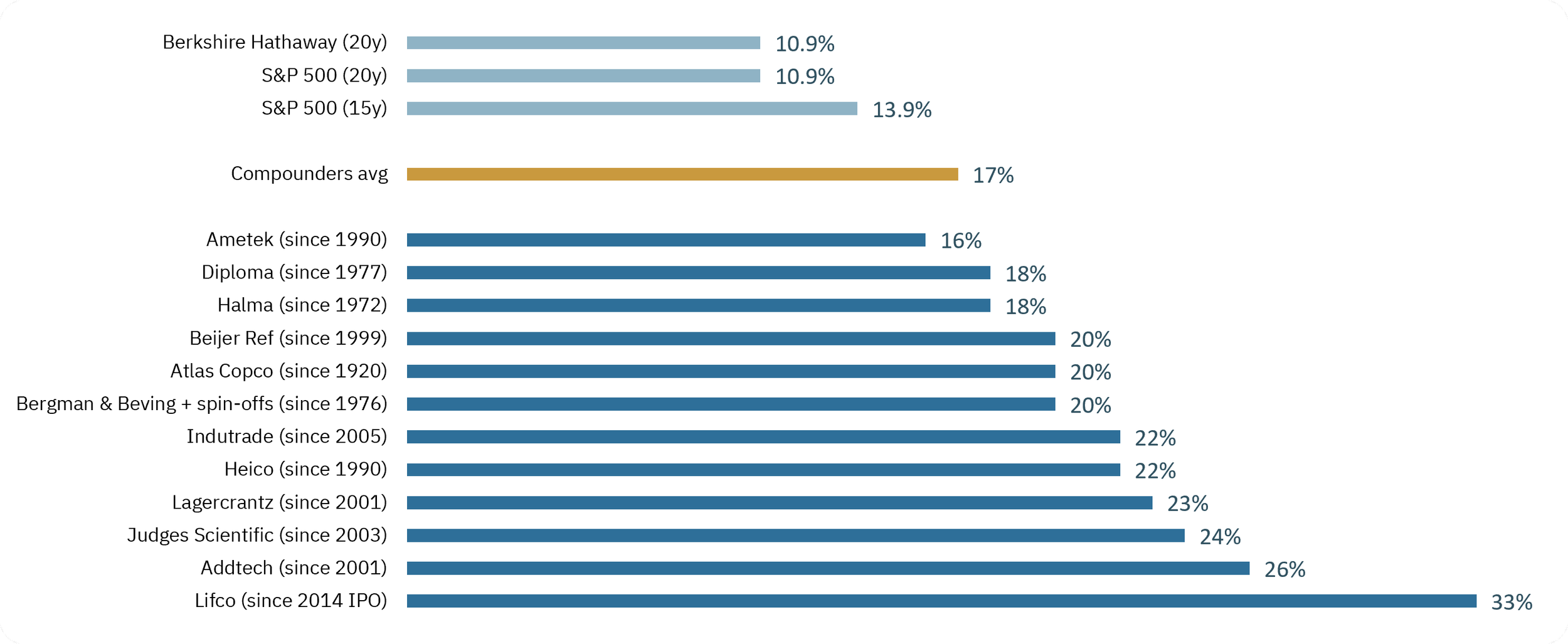
Programmatic Compounders delivered 16-26% annual Total Shareholder Returns over decades (July 2025 ; TSR Dividends Reinvested)
The model has been the superior private-capital wealth-creation engine in Northern Europe and the United Kingdom for over a century, with 50+ publicly listed practitioners proving it on a quarterly basis. It predates the modern US private equity industry by approximately seventy years. What is new is the attempt to revive it at the unglamorous lower-middle-market end, just as Berkshire and Constellation have grown beyond it.
"Berkshire is not the most attractive investment in the world, if you are willing to go through those thousands of small companies. This is how we started, but our size does not allow it anymore" - Warren Buffet
When arithmetic conspires in favor of returns
The reason these acquirers deliver such returns, and US private equity does not, has at least as much to do with arithmetic as with skill. Three multipliers operate in parallel.
First, Compounders jump EV/EBITDA multiple ‘zones’.
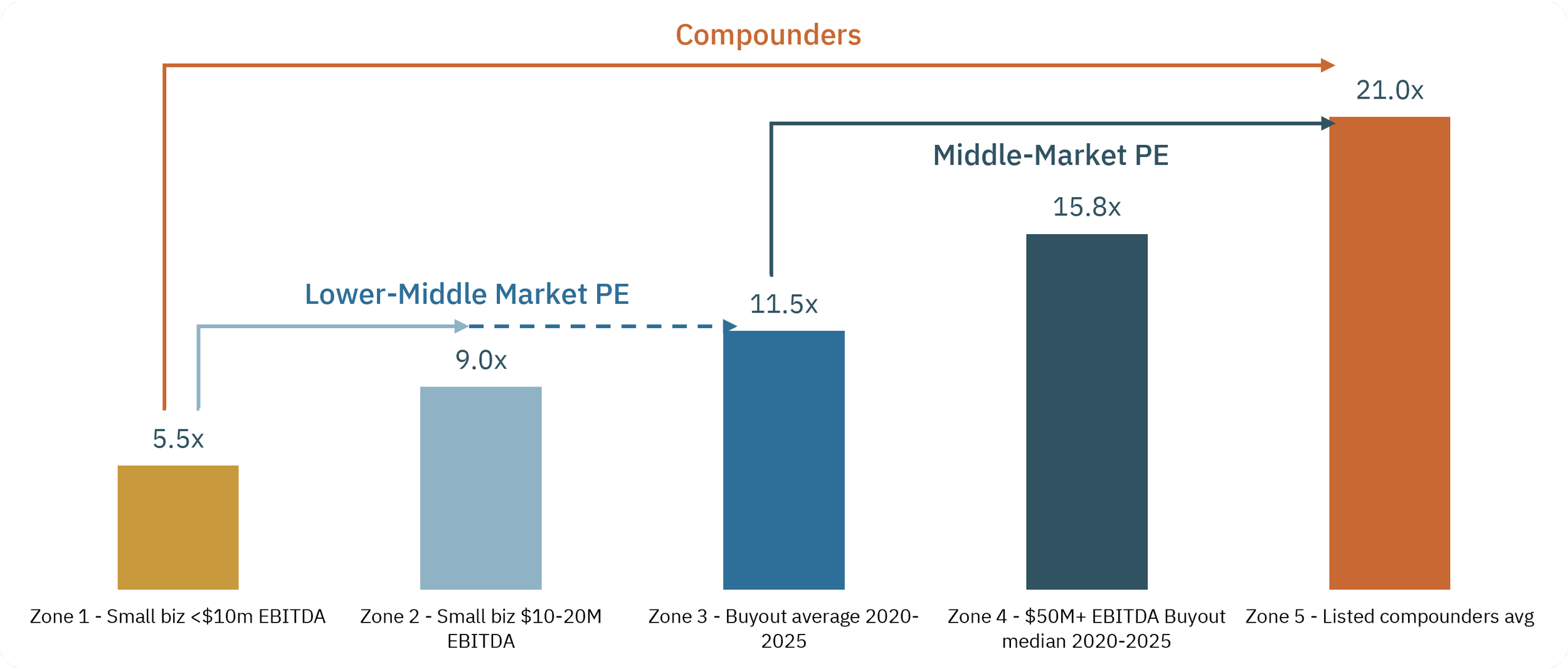
Most serial acquirers disclose buying at 5-7x EBITDA, avoiding the sub-scale 3-4x cheap end and the hot-vertical premium 8-9x end. Where a lower-middle-market PE fund injects cash and energy to lift each portfolio company's EBITDA in pursuit of one to four points of multiple expansion, the compounder focuses all its energy and resources in acquiring more solid EBITDA. This places the consolidated entity in EBITDA zones that public markets are rewarding at 18-25x, averaging around 21x, delivering a 12–19-point multiple uplift. Even at $12B in revenue, Constellation has traded at a ten-year median multiple of roughly 22.5x.
Second, compounding to its literal definition, indefinitely.
When an LP commits one dollar to an effectively 20/20 fund, once fees and LP expenses are deducted, roughly 75 cents are deployed into targets over a six-year investment period. In a serial-acquiring, subsidiary-consolidating holding company, the same dollar deploys approximately two dollars over the same period, a 2.7x mechanical multiplier from the absence of fee drag and the recycling of acquired cash flows. An investing team with picking ability merely on par with the PE industry would see returns multiplied by close to 3x on that effect alone. Six years later that same dollar has been deployed four times. Twelve years out, eight times, etc. 2^(n six-year periods): the literal mathematical definition of compounding, a tag buy-and-sell investors use freely while lacking the horizon and structure required for it to apply. Berkshire has compounded its streamed up dividends, then added insurance float, for over 60 years: an over 2^10 = 1,024 multiplier.
“Compound interest is the eighth wonder of the world” - Albert Einstein
Third, the holding company is listable
Directly listable in fact, as they typically don’t need to raise more capital. Yet another capital-efficient possibility largely overlooked in the United States despite being cheaper, faster and immediately market-priced than an IPO. Funds however cannot be listed and must go through the struggle of individual Portco exits. Bain reports approximately 32,000 unsold PE portfolio companies globally, worth roughly $3.8 trillion, the deepest exit drought in PE history.
What the model deliberately does not do completes the arithmetic. It does not over-lever, with debt typically contained at around 2x EBITDA. It has no incentive to write large equity checks. It does not stack overhead. It does not waste focus on perpetual fundraising or PortCos exits. It does not chase Excel-defined, unrealized IRRs.
The structural valuation arbitrage: Compounders acquire in Zone 1, consolidate financials, exit in Zone 5
If the math is this clean and the model this proven, the natural question is why so few attempt to build a $5B American Lifco? Beyond a clear dose of not-invented-here syndrome, experts agree on four main explanations:
Capital-structure mismatch.
The American institutional LP base is organized around closed-end funds with ten-year lives, quarterly performance tracking, an illiquidity premium and frequent distributions. The same LPs who would, in hindsight, have rushed to back Berkshire or Constellation when private now struggle to evaluate their modern equivalents. Dozens of new fund offerings sit on their desks with more enticing narratives than: be patient, enjoy DCF and RoE, a great MOIC will arrive at IPO, expect no distributions before then, we only buy non-glamourous businesses and abide by a non-glamourous no ‘value-add’ model. Röko started with capital from 130 individuals and almost no institutions, then delivered roughly 10x in five years.
Sponsor incentive misalignment.
The PE fee + carry structure rewards scaling fund size, increasing GP compensation pool, and rewards fast exits. The model that compounds best is the model GPs are least incentivized to build. For it requires investing-talent willing to stay under the radar, have no glamourous stories to socialize with, and to wait for an IPO to realize personal wealth. Buffett's framing applies: American investors do not want to become rich slowly. Leonard built Constellation in obscurity for eleven years and stayed away from analyst calls. Most large US LPs also rely on employed staff for allocation decisions, and that staff's incentives are themselves misaligned, economically and in the more fundamental sense that, as the saying goes, no one was ever fired for buying IBM.
A sharp tension between allocating at scale and seeking returns.
As the American market got increasingly flooded by the confluent liquidities from Quantitative Easing, the Middle-East, Sovereign Wealth Funds, and the earning from a generally very bullish market, US PE rose to managing over $5 trillion in AUM, and needs to deploy over $1 trillion of dry powder, transforming big PE effectively in asset managing houses. The need for both LPs and GPs to deploy such staggering figures inevitably triggers the law of diminishing returns. With largest 10 firms capturing 50% of new capital, only big looks beautiful, and powerful fear-of-missing-out dynamics pressure the LP community.
And yet, the world’s largest SWF is Norwegian, with $2 trillion under management, and an avid investor in their neighboring Compounders.
Last but not least, cultural orientation.
The US private-capital originated in active- ownership roots, initially targeting ‘under-managed’ assets, when not plain distressed, and requires headline-friendly narratives and language to justify its fees and sustain its never-ending marketing efforts. The Nordic doctrine rests on a different premise: that one preserves what one buys, does not interfere, and that smaller targets and patience mechanically deliver higher and more predictable returns. Beneath sits the Nordic principle of responsible freedom, which makes radical decentralization culturally native rather than tactical. The American instinct, by contrast, leans interventional, which in PE shows up as proliferating "value-add" theses and inflated operating teams.
Meanwhile, US PE alpha has taken a back seat. Risk-adjusted returns even more so. And the once dubbed ‘barbarians at the gate’ have mostly morphed into giant asset managers.
“Culture eats strategy for breakfast” - Peter Drucker. He could have added ‘returns’.
The American anomaly
A McKinsey 2024 analysis found that approximately two-thirds of total returns for buyout deals entered in 2010 or later and exited by 2021 came from leverage, M&A and the resulting market multiple expansion (add-on acquisitions is a steady 73-76% of all US PE buyout activity). Not from operating improvement, i.e: organic growth and margin improvement, which is what inflated PE operating teams are nominally there to deliver. US buyout has primarily become a roll-up business funded by leverage and rewarded by multiple arbitrage, marketed to LPs as operating alpha.
Cracks are becoming apparent on the other end of the equation: exits and distributions. Bain's 2025 Global PE Report shows distributions as a share of NAV at roughly 11% in 2024, the lowest in over a decade and well below the 2014-2017 average of approximately 29%. The five-year rolling DPI for buyout funds hit its lowest recorded level in 2025 (McKinsey). The buyout industry five-year net-of-fees alpha has compressed to a mere ~1.0-2.3% per year, hardly any premium for illiquidity.
Moreover, the imperative to deploy ever-larger checks has come at the cost of materially higher risk at both fund and portfolio-company levels, and a jammed exit route. The industry's response has been to manufacture liquidity rather than to find it: total secondary transaction volume reached approximately $162 billion in 2024 (Jefferies), up 45% year over year, with GP-led volume at a record $75-84 billion of which continuation vehicles represented roughly 84% (Evercore). These structures often move trophy assets from one of a sponsor's funds into another, with the same GP on both sides: intra-house recycling presented as exit activity.
In sharp contrast, Lie and Martinsen's peer-reviewed 2022 study at the Norwegian School of Economics, covering Nordic Compounders totaling 5,473 deals from 2006 to 2021, concluded they generate 0.88 to 1.32% points of monthly alpha after Fama-French factor controls, equivalent to ~11-17% per year of risk-adjusted outperformance of the S&P500. And did so with materially lower correlation to public-market drawdowns than either US PE or the S&P 500, as underlying earnings come from hundreds of small private operating companies marked to operating performance, not to multiples.
And yet, the evidence stack
Nordic Compounders
11-17%
Annualized Alpha - 2006-2021
~10x
US Buyout
1-2%
Annualized Alpha - Same period
Dear reader, if you have read this far, you are likely one of two types of capital allocators:
The operator-turned principal-allocator, possibly structured as a family office, who recognizes the compounder model as the formalization of how multi-generational industrial families have always earned capital: patiently, relying on your long-standing management team, focused on free cash flow, and mistrustful of excessive leverage or Excel and PowerPoint-manufactured value-increase plans (a former McKinsey Partner here writing).
Or the institutionalized allocator already actively shifting your allocations from standard funds towards more direct investing, in search of truly differentiated and cash-IRR / MOIC centric, disappointed by American PE’s disconnect between narrative and actual cash returns, and possibly regretting not having rather allocated some of your LP monies in the most basic ETFs such as VOO or VGT which in the past 15 years have respectively returned a net ~15% and ~20%, beating PE median and top-quartile
We are a quiet yet growing number of seasoned investors who are pivoting from ‘Buy and Sell’ in their various shapes, towards building Nordic-like Compounders in the United States. Most still feel compelled to ‘at least’ be vertical specialists, ideally in more glamorous spaces (e.g: medical practices, accounting firms, IT services, etc) and to add some value.
Others embrace the model’s exact 120-years proven recipe, and yet again confirmed by Röko as recently as 2024, and no matter how non-main-stream it may be perceived around us
That is what we are doing with my new vehicle, Perpetuo Group, after over 15 years of Buy and Sell with 22 Exits returning 8.6x MOIC so far. We chose to stand on the shoulders of so many powerful and open-source role models, adding only one spin: while we are very much resolved to not acquire businesses that appear fragile to AI, we heavily use AI in our deal sourcing and making (with about 15 agents handling ~50 new deals per week, in the week, what was the job of ~3-5 M&A juniors).
I welcome a conversation with any investment professional who finds these evidence and structural arguments persuasive, recognizes the urge to go back to first principles, is willing to trade patience for such returns potential, and wants to look at how it gets executed.
Cyril Grislain
Founder & CEO
Deloitte-audited 8.6x MOIC returning investor. Previously a Partner at McKinsey & Company
cyril.grislain@perpetuogroup.com
SOURCES:
REQ Capital, A Deep Dive into Shareholder Value Creation by Acquisition-Driven Compounders, 2025.
Adnan Hadžiefendić, Dybvad Oddbjorn and Kjetil Nyland, Compounders: From Small Acquisitions to Giant Returns, 2025.
T. Lie & Martinsen, The Performance of Acquiring Firms in the Nordic Market, Norwegian School of Economics, 2022.
McKinsey, Bridging Private Equity's Value Creation Gap, 2024; Global Private Markets Report 2026; How lots of small M&A deals add up to big value; Practice makes perfect: What sets programmatic acquirers apart.
Bain & Company, Global Private Equity Report 2025; Private Equity Midyear Report 2025.
Cambridge Associates, US Private Equity Index, 2024 and 2025 updates.
Jefferies, Global Secondary Market Review, January 2025 and H1 2025.
Evercore Private Capital Advisory, FY 2024 Secondary Market Review.
Pitchbook, Q2 2025 US PE Breakdown.
Slow Compounding, Röko AB: Can Fredrik Karlsson Build Another Lifco?
Roll-Up Europe, Walking away from a $6M/y job to build a $600M+ revenue HoldCo, 2025.
Buyers and Builders, A Serial Acquirer Masterclass and The Story Of 47 Acquisitions Per Year, 2026.
Quartr, The Three Cornerstones of Serial Acquirer Success
In Practis, Halma, Danaher, CSU & Serial Acquirer Org Structures, 2022.
Berkshire Hathaway Shareholder Letters
GF Data, H1 2025 Middle Market M&A Report.
Forvis Mazars, Q2 2025 Middle-Market M&A Insights.
StockAnalysis.com, Yahoo Finance, NYU Stern Data, Preqin, Financial Times, Lazard, Reuters.
Company websites, listing documentations and financial reports
This paper reflects the views of the author. It is not investment advice and does not constitute an offer to sell or a solicitation of an offer to buy any securities. Any such offer or solicitation will be made only by means of definitive offering documents